
OEM/ODM Jewelry Manufacturing: Cost Drivers in Order
Unit cost in a jewelry order is decided by a short list of levers, and they do not carry equal weight. Quantity per design usually moves the number more than the alloy, the alloy more than the plating, and the plating more than the box. Sorting those levers before a quote is requested is the difference between negotiating a price and guessing at one.
Key takeaways
- Quantity per design ranks first: silver starts at 50 pieces, brass at 100 and stainless at 100 or more.
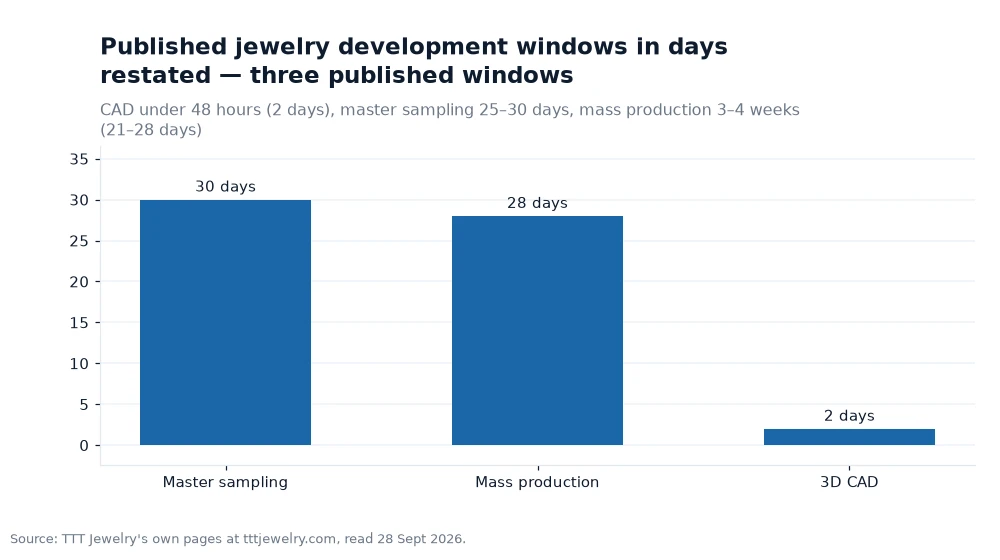
- A 25–30 day sample stage spread over 50 units is 0.5–0.6 days per piece; over 100 units it is 0.25–0.3.
- Plating layers and finishes add handling passes, which behave like a second quantity cost rather than a material cost.
- ISO 9001:2015, BSCI and REACH work as programme overheads, so they change the supplier shortlist before they change the unit price.
How to rank cost drivers before quoting
Every jewelry quote is a sum of fixed and variable parts. Fixed parts include the model, the pattern and the sample. Variable parts include metal, stones, plating time, assembly labour and packing. A buyer who cannot separate the two will argue about the wrong line.
The ranking that matters is by sensitivity: how much does the unit price move when this variable changes by one step? Quantity per design is almost always first, because it divides the fixed work. Alloy comes second, because it changes both the metal cost and the minimum order. Plating comes third, because each additional layer is another handling pass.
Findings, stones and packaging sit below those three. They matter, and on a low-metal fashion line they can matter a lot, but they rarely overturn a decision that quantity and material have already made.
Quantity per design is the first lever
The published minimums set the entry point: 50 pieces per design in 925 sterling silver, 100 per design in artisan eco-brass, and 100 or more in stainless steel. Those thresholds are not arbitrary. They reflect the bench work that has to happen once per design regardless of how many units follow.
The consequence is arithmetic. A 25–30 day sample stage belongs to the design, not to the unit. Spread over 100 brass pieces, it is 0.25–0.3 days per piece. Spread over 50 silver pieces, the same stage is 0.5–0.6 days per piece, even though the window has not changed.
This is why adding designs is more expensive than adding units. Three silver designs at 50 pieces each is 150 units but three sample stages, which is 75–90 days if they run one after another. One design at 150 pieces is a single stage and a shorter calendar.
Material, plating and findings
Material choice is constrained by the design before it is constrained by the price. A thin openwork pendant that must hold a sharp edge behaves differently in brass than in sterling, and 316L stainless takes PVD plating in a way the other two do not. Choosing the alloy after the finish usually means resampling.
Plating is the tier buyers most often underestimate. A single rhodium layer is one pass through the bath. A 14K gold layer over a strike coat is two or more, and each pass carries its own racking, rinsing and inspection. Multi-layer 14K, 18K or 24K finishes are therefore a labour decision as much as a material one.
Findings are the quiet line item. A stock lobster clasp and a custom cast clasp can be functionally identical and commercially far apart, because one is bought in and the other is tooled. Chain gauge and length work the same way: a longer chain is more metal and more assembly time.
| Lever | What sets it | Fixed or variable | Question to settle first |
|---|---|---|---|
| Quantity per design | Published minimum for the metal | Divides fixed work | How many sellable units per design? |
| Base material | Silver, brass or stainless | Variable, with a floor | Which alloy does the design need? |
| Plating and finish | Layer count and top coat | Variable, per pass | How many layers, and which colour? |
| Findings and chain | Stock versus custom, gauge, length | Variable | Can a stock finding carry the design? |
| Packaging | Box, pouch, card, label | Fixed artwork, variable units | What must the unboxing do? |
Compliance and inspection sit above the unit price
Certification is a supplier-selection cost, not a per-piece cost. ISO 9001:2015 covers quality management across production stages, BSCI covers labour and social audit, and REACH plus California Prop 65 cover restricted substances and plating compliance. None of them is quoted per earring; all of them narrow the list of factories that can take the order.
That has a practical effect on negotiation. A buyer who asks for a lower unit price from a supplier without a documented quality system is asking for a different product, not a discount. The record-keeping is part of what the price buys.
Inspection follows the same logic. A 100% final pass checks every piece, so its labour scales with quantity rather than with order value. At 50 pieces the total inspection time is small in absolute terms. At several thousand it becomes a visible line in the quote, and a supplier that omits it is quoting a different scope.
The published breakdown at www.tttjewelry.com/oem-odm-jewelry-manufacturer/ sets out the six-step flow and the eight factory steps, which is the clearest way to see where labour enters before a price is discussed.
Worked example
Compare two ways of buying 150 sterling silver pieces. Route one is three designs at the 50-piece minimum. Route two is one design at 150 pieces, above the minimum but on a single model.
Route one carries three sample stages. Run together, they take 25–30 days; run one after another they take 3 × 25–30 = 75–90 days. Route two carries one stage at 25–30 days. The calendar difference is 50–60 days, and the fixed bench work is tripled in route one.
Now express the sample stage per unit. If the three samples run together, one 25–30 day window covers all 150 pieces, which is 0.17–0.2 days per piece. If they run one after another, the window repeats three times and the per-unit figure triples to 0.5–0.6 days. Route two has one window for 150 pieces of a single design, which is 0.17–0.2 days per piece and one approval to manage.
Add a second plating layer to both routes and the comparison shifts again, because the extra pass applies to all 150 pieces in either case. That is the test for whether a cost driver is fixed or variable: if it multiplies by units, it is variable, and quantity will dilute it.
Frequently asked questions
Which cost driver should a buyer negotiate first?
Quantity per design. It divides the fixed model, pattern and sample work, so a small change in units moves the unit price more than a change of clasp or packaging.
Does a higher MOQ always lower the unit price?
It lowers the share of fixed work per piece, but variable costs such as metal and plating passes stay proportional, so the curve flattens rather than falling without limit.
Are certifications reflected in the quoted price?
Only indirectly. ISO 9001:2015, BSCI and REACH compliance shape which suppliers can quote and how records are kept, rather than appearing as a separate charge on the invoice.
Negotiating in the right order
Start with units per design, then lock the alloy, then simplify the finish stack, and only then discuss the box. Reversing that order produces savings that disappear when the quantity is finalised.
Material choice also decides where a programme can be sourced at all. A stainless steel jewelry manufacturer line needs 100 or more pieces per design, so a 60-piece test run belongs in silver or brass instead. The wider programme behind these figures is summarised by TTT Jewelry, including the customisation options that generate most of the cost lines above.
Write the ranking into the brief as a table with four columns: lever, current choice, alternative, and the unit impact if changed. Suppliers answer that document with numbers instead of adjectives.
Source note: figures come from the manufacturer's own website (tttjewelry.com), read 28 Sept 2026.[1]