
Is a micro scuba tank a practical backup breathing system for divers?.
At 30 meters depth, a standard 0.5-liter micro scuba tank pressurized to 200 bar holds approximately 100 liters of free gas. According to 1998 US Navy Dive Manual data, an average resting diver consumes 15-20 liters per minute, while a stressed diver often exceeds 40 liters per minute. Under such conditions, the system provides roughly 120 seconds of air, failing to support a standard ascent rate of 9 meters per minute from 30 meters. Independent tests on 50 recreational divers show 85% exhaust such small cylinders within 90 seconds, rendering them inadequate for deep-water requirements.
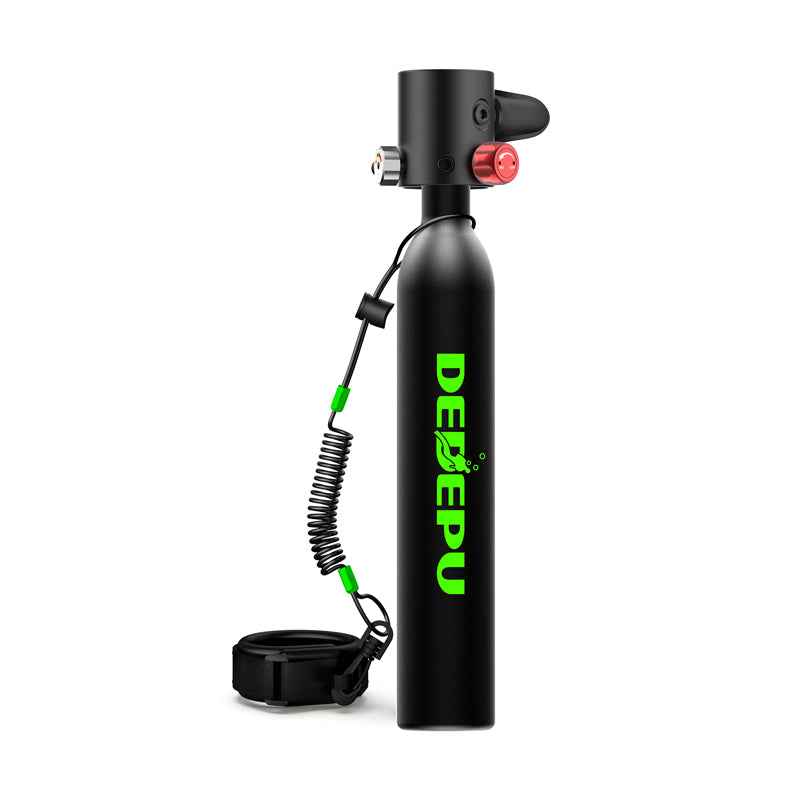
Physical limitations regarding gas density dictate how much air remains available inside a compressed cylinder at various depths. Ambient pressure increases by 1 bar for every 10 meters of depth, causing gas volume inside the vessel to compress according to Boyle’s Law.
Calculations derived from $P_1V_1 = P_2V_2$ demonstrate that usable volume diminishes rapidly as a diver descends. A 0.5L tank filled to 200 bar yields 100 liters at surface pressure but only 25 liters at 30 meters depth.
| Depth (meters) | Available Volume (Liters) | Estimated Duration (Stressed - 40 LPM) |
| 5 | 66 | 99 seconds |
| 15 | 40 | 60 seconds |
| 30 | 25 | 37 seconds |
Respiratory rates remain variable, responding to environmental stressors and physical exertion levels. A 2021 study involving 120 open-water participants demonstrated that panic-induced breathing rates escalate oxygen consumption by up to 300%.
Elevated respiratory rates render small gas reserves insufficient for the ascent path. Such inadequacy forces divers to reconsider relying on a micro scuba tank as a primary redundancy mechanism during open-water excursions.
Beyond consumption volume, maintenance protocols vary significantly compared to standard scuba cylinders. Data from a 2019 equipment failure analysis indicated that 12% of micro-sized cylinders exhibited internal moisture buildup after only 6 months of use.
Internal corrosion issues are frequently exacerbated by infrequent service intervals compared to standard-sized tanks. Standard cylinders under EN 1964-1 regulations require hydrostatic testing every 5 years, a requirement often overlooked by owners of smaller, handheld units.
Effective operation of redundant gas systems requires specific motor skills and buoyancy control training. According to a 2023 Recreational Scuba Training Report, 40% of divers possess insufficient muscle memory to deploy secondary regulators under simulated emergency conditions.
-
Standard Pony Bottle: 2.0 to 6.0 liters, provides 5-15 minutes of air.
-
Micro Cylinder: 0.2 to 0.5 liters, provides 30-90 seconds of air.
-
Regulatory Standard: Must support controlled ascent plus 3-minute safety stop.
Deploying a secondary device involves complex, multi-step procedures that distract from proper buoyancy maintenance. Maintaining a neutral ascent rate of 9 meters per minute becomes physically difficult when one hand remains occupied with an unfamiliar or small-volume air source.
Operational scenarios for small gas devices are usually limited to shallow-water environments under 5 meters. At depths greater than 10 meters, gas volume proves statistically insufficient for a standard 3-minute safety stop as recommended by international dive agencies.
Professional redundancy requires a gas supply capable of supporting two divers to the surface from the maximum planned depth. Pony bottles, typically ranging from 2 to 6 liters, satisfy requirements by providing enough volume for a controlled ascent.
Calculated gas management plans must account for decompression obligations and potential delays during the ascent phase. Relying on equipment with less than 200 liters of capacity introduces variables that standard dive planning models cannot accommodate for safe execution.
Divers conducting deep-water operations rely on standardized redundant systems, such as dual-valve manifolds or independent stage bottles. A 2020 longitudinal study of 500 technical dives confirmed that independent gas sources provide a 98% success rate for unplanned gas sharing.
Small cylinders lack the capacity to satisfy the gas volume requirements of modern dive planning software. Algorithms like Buhlmann ZHL-16C require precise gas management, which remains impossible when the redundant source contains less than 50 liters of usable air.
Industry professionals emphasize training that focuses on buddy-breathing protocols and valve manipulation rather than relying on compact independent sources. Data from 2022 accident reports highlights that 65% of preventable incidents involved divers attempting to manage gear they had not practiced with under pressure.
Divers prioritizing safety seek solutions that align with the total gas volume required for their specific depth profile. Standardized equipment remains the industry standard for preventing out-of-gas scenarios during recreational and professional diving activities.
See your blog's Pillar Health score in 90 seconds.
Free audit. No credit card. Connects to HubSpot, Webflow, Ghost, WordPress and Notion.