
What to Prepare Before the First Call on a Value Fragrance Line.
The first call with a fragrance manufacturer is not a discovery meeting for the factory; it is a discovery meeting for the brand. Manufacturers learn more from what a buyer brings than from what a buyer asks, because the preparation reveals whether the project has a defined market, a budget and a decision-maker. A brand that arrives with three numbers, two decisions and one sample brief will get a usable answer in half an hour. A brand that arrives with enthusiasm and no figures will get a general presentation and a request to come back later, which is the most expensive outcome of the whole sourcing process because it wastes the only meeting where the manufacturer is genuinely motivated to help.
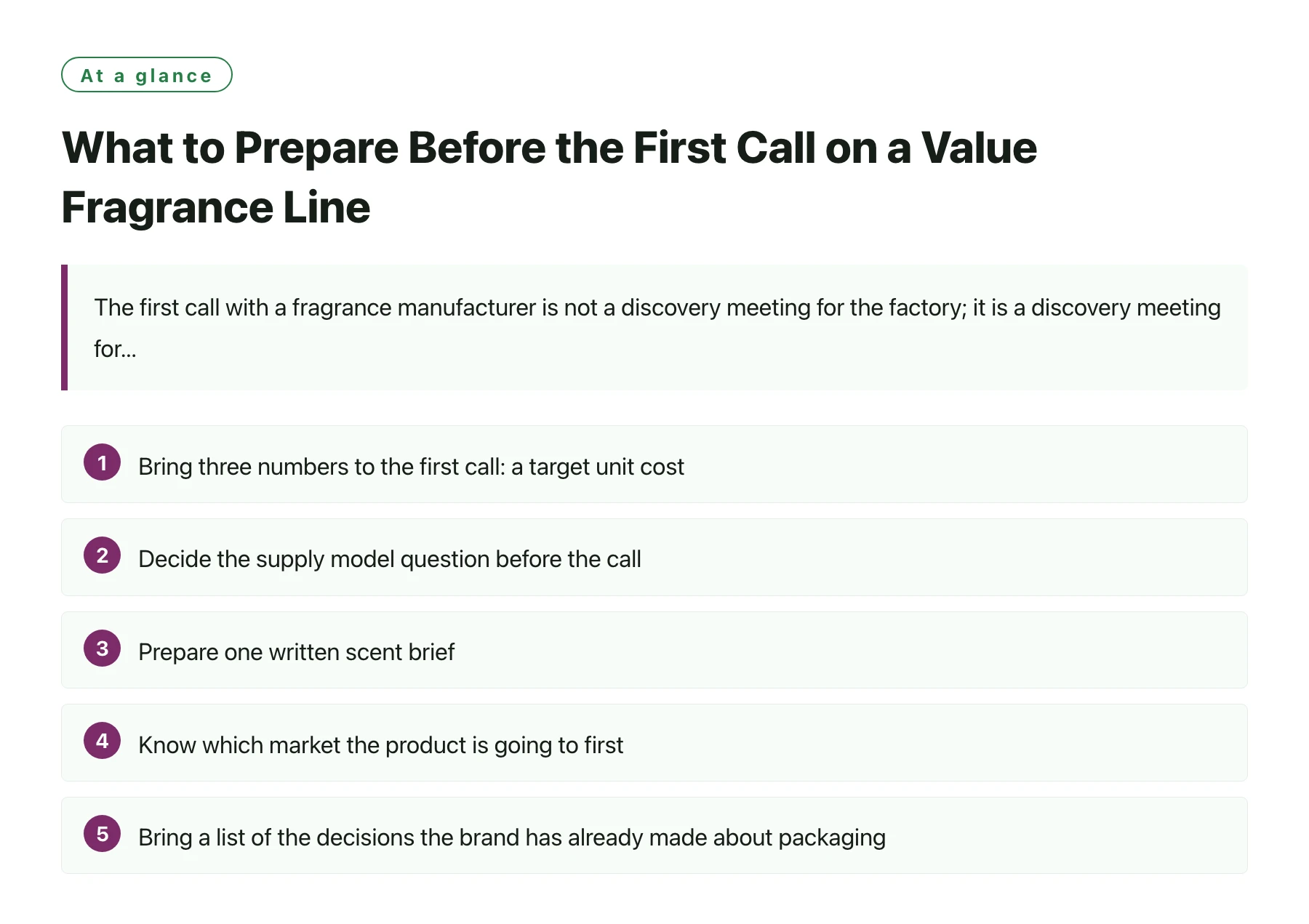
Key takeaways
- Bring three numbers to the first call: a target unit cost, an expected first order quantity and a target retail or launch date.
- Decide the supply model question before the call, or at least arrive with a preference and the reasoning behind it.
- Prepare one written scent brief, even an imperfect one, because a factory can react to a brief and cannot react to an intention.
- Know which market the product is going to first, since it changes the documentation the manufacturer has to prepare.
- Bring a list of the decisions the brand has already made about packaging, and a short list of the ones still open.
- The most informative answer in the whole call is often the manufacturer's reply to what it would advise against in this project.
Most guidance about first calls focuses on questions to ask. Questions matter, but the framing is backwards for a value line: a manufacturer that receives ten good questions and no numbers can only answer in generalities, because the answers genuinely depend on volume, target price and market. Preparation is what converts a general answer into a specific one.
The list below is deliberately short. It is not a business plan and it does not need to be complete. It needs to be specific enough that the factory can say something useful about feasibility, cost and timing within the first conversation, and honest enough that the brand does not discover a fundamental problem three sample rounds later.
The prep pack, item by item
| What to bring | Why the factory asks for it | What a good version looks like |
|---|---|---|
| Target unit cost | Determines which compositions, packaging and decoration options are worth discussing | A range with a preferred point, stated on a defined cost basis |
| First order quantity and reorder expectation | Sets the minimum order conversation and the packaging tooling decision | A first quantity the brand can pay for, plus a realistic annual figure |
| Destination market | Changes the documentation, the declaration and sometimes the formulation | One primary market named, with secondary markets listed separately |
| Launch date and retail window | Establishes whether the schedule is achievable before work starts | A date with the reason attached, such as a season or a listing deadline |
| Written scent brief | Gives the perfumer something to react to instead of a direction to guess at | Two or three reference directions, an occasion and what to avoid |
| Packaging decisions already made | Avoids pricing a product that cannot be built as described | Bottle format and cap decided, decoration options still open |
The third column is the standard to aim for. A brand that can fill it in for every row will find the first call productive even if the manufacturer turns out to be the wrong partner.
The three numbers that change the conversation
Target unit cost is the first, and it should be stated as a range rather than as a wish. A manufacturer can work with a band and can explain what has to give at the bottom of it. A single unrealistically low figure often ends the useful part of the conversation politely and early.
First order quantity is the second. It does not need to be impressive; it needs to be honest. A small first order is a normal starting point for a value line, and a factory that cannot serve it should say so on the first call rather than after three weeks of sampling. The third number is the launch date, and attaching a reason to it matters because it tells the manufacturer which parts of the schedule are movable. A date driven by a seasonal listing is treated differently from a date driven by impatience, and both are legitimate, but only one can be planned around.
These three numbers also let the manufacturer tell the brand something it could not otherwise hear: whether the project is internally consistent. A very low target cost with a very small first order and a very short lead time is not a difficult project, it is an impossible one, and hearing that in the first call is worth more than any quotation.
Deciding the model before the call
The choice between supplying a defined formula and asking the manufacturer to develop or adapt one changes nearly every answer a factory will give. It affects cost, timeline, ownership and even whether the project can start without more work on the brand's side. A brand that arrives without a preference will usually be steered towards whichever model the manufacturer prefers, which may or may not suit the plan.
The preference does not need to be final, but it should be argued. A brand that says it wants a hybrid, using an existing composition with a modest adaptation, is giving the manufacturer something concrete to price. That intent can be stated early: this brand is looking for fragrance OEM/ODM production partner support that includes adapting an existing composition rather than developing from scratch.
It is also worth arriving with a view on who owns the composition. That question is easier to raise before a quotation than after, because it changes what the manufacturer can offer. A brand planning to reuse the scent across products needs a different arrangement from one that expects the composition to stay with the factory, and the difference is better settled early. The World Intellectual Property Organization publishes practical guidance on handling intellectual property in commercial relationships, including the value of writing ownership and permitted use down rather than leaving them implicit [3].
What to say about ownership in the first call
Keep it simple: state whether the brand expects the composition to be exclusive, whether it plans to reuse it in other products, and whether it would ever want to move production. Those three answers tell a manufacturer everything it needs to propose an appropriate structure, and they cost nothing to prepare.
Questions to have ready for them
Preparation is not only what the brand brings; it is also what the brand is ready to ask. The questions that produce usable information are specific: what is the sampling process and how many rounds does the fee cover, what is the smallest repeat order, who supplies the compound and who signs off the documentation, what decoration options are available in house, and what has to be true for the launch date to be met.
It is worth asking about documentation before asking about price, because the answer reveals whether the manufacturer treats compliance as routine. A brand buying a product for a regulated market should know who will prepare the safety assessment, who issues the allergen position and what changes if the formula does. Two reference points make those answers easier to judge: use restrictions for fragrance materials are set by industry standards that a factory should be able to explain [1], and the destination market's own cosmetic rules determine what documentation has to accompany the product [2]. Buyers who want a broader list of evaluation questions, including ones that only become relevant later in the process, can find a detailed set in this guide to the questions to ask a perfume factory.
One question is worth asking for a different reason: what would the manufacturer advise against in this project? A supplier that answers honestly, whether about decoration, timing or the target price, is showing how the rest of the relationship will go. A supplier that agrees with everything in the first call is telling the brand that the disagreement will happen later, at a worse moment.
What not to prepare, and what to leave open
Not everything needs to be decided. Packaging decoration, final artwork, carton specifications and the full range plan can all be open on the first call, and bringing half-finished versions of them can distract from the decisions that matter. The useful distinction is between decisions that change the answer and details that do not. The market, the quantity, the target cost and the model change the answer; the cap finish does not, at least not in the first conversation.
There is also no need to arrive with a finished brand story. Manufacturers are not the audience for it, and a long presentation displaces the time available for the questions above. What is useful is the product concept in a sentence and the reason for the price point, because both influence how the factory thinks about the brief.
It is worth being honest about experience. A first-time founder who says so will usually receive a more structured explanation of sampling, approvals and timelines, which is exactly what a value line needs to avoid a costly misunderstanding. Pretending to more experience than the brand has tends to shorten the explanation at the moment it is most valuable. It also helps to have read the manufacturer's own material in advance, because Xuelei's presentation of Xuelei's manufacturing background is the kind of page that should raise specific questions rather than close them.
The one-page version
Everything in this checklist fits on one page: three numbers, one market, one written brief, one model preference, one ownership position, and the packaging decisions already taken. That page is the whole preparation. A brand that cannot yet fill it in does not need more meetings, it needs two or three internal decisions, and making them now is cheaper than making them after a quotation exists.
A practical habit before any first call: read the manufacturer's own description of its services and write down the two questions it does not answer. Those are the questions for the call, and they are usually more revealing than the ones already covered on the site. A page describing perfume OEM manufacturer in China work is a fair example of what a manufacturer chooses to explain about itself, and noticing the gaps in it is the whole point of the preparation.
Sources
- IFRA Standards Library (International Fragrance Association) —— The IFRA Standards Library lists the restrictions the fragrance industry applies to individual fragrance ingredients, based on safety assessments; it is the reference point for compliant fragrance formulation.
- European Commission: Cosmetics in the EU —— The European Commission's overview of EU cosmetics rules, including the responsible person, product information file and safety report requirements.
- WIPO — World Intellectual Property Organization —— The UN agency for intellectual property; resources on industrial design and patent protection relevant to product and packaging design.
Frequently asked questions
What should a brand bring to a first call with a fragrance factory?
Three numbers (target unit cost, first order quantity, launch date), one destination market, a written scent brief, a preference on the supply model, a position on formula ownership, and the packaging decisions already made. One page is enough.
Do I need a finished brief before the first call?
No, but you need something written. Two or three reference directions, the occasion the product is for and anything it must avoid give a perfumer a basis for a first proposal, which is far more useful than a verbal description.
Should a small first order be disclosed on the first call?
Yes. A manufacturer that cannot serve a small first order needs to say so immediately, and one that can will often propose a structure that makes the small order workable. Concealing the size only delays the conversation to a more expensive stage.
What is the most useful question to ask a fragrance manufacturer first?
Ask what it would advise against in your project. The answer shows whether the manufacturer is willing to give an unwelcome opinion, which predicts how it will behave when a problem appears in the middle of an order.
See your blog's Pillar Health score in 90 seconds.
Free audit. No credit card. Connects to HubSpot, Webflow, Ghost, WordPress and Notion.